Chipotle Macros: Protein, Carbs & Fat Guide
Use this guide to compare Chipotle macros across proteins, rice, beans, toppings, extras, and meal formats. The current production dataset tracks serving-specific protein, carbohydrates, and fat alongside calories, so you can understand individual ingredients before calculating the complete order you actually plan to eat.
DATA & TRUST
Nutrition data reviewed: September 2026
Focus: Protein · Carbohydrates · Fat · Calories
Market: U.S. menu
Independent informational resource. Not operated by, sponsored by, endorsed by, or affiliated with Chipotle Mexican Grill, Inc. Nutrition values are estimates and restaurant portions can vary.NEED A FULL MEAL TOTAL?
Use the Chipotle Nutrition Calculator to choose a meal type, goal, starting point, ingredients, and supported portions. This page explains the macro patterns; the calculator combines them into a complete meal estimate.
What Are the Main Chipotle Macros?
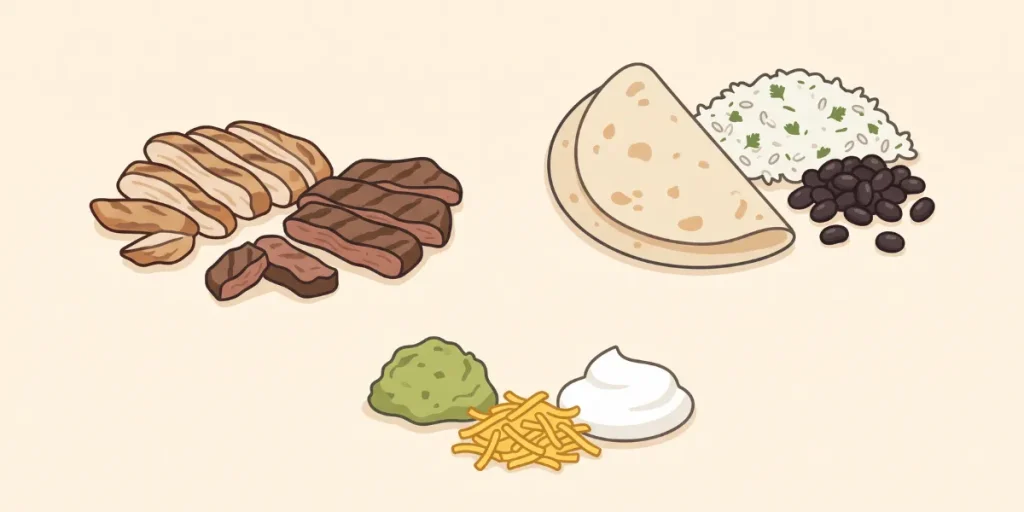
When people talk about macros, they usually mean the three macronutrients below.
| Macro | What it represents on this site | Common contributors in a build |
|---|---|---|
| Protein | Grams of protein from selected ingredients | Main protein, beans, cheese, queso, tortilla and other ingredients |
| Carbohydrates | Grams of total carbs | Tortillas, rice, beans, salsas, sides, drinks and other carb-containing items |
| Fat | Grams of total fat | Proteins, tortilla, cheese, sour cream, guacamole, queso and other additions |
Calories are useful alongside macros, but calories are not a fourth macronutrient. Two ingredients can have the same calories and still have different amounts of protein, carbs, fat, fiber, or sodium.
That is why macro comparisons are more useful when you compare the nutrient profile instead of judging an ingredient from calories alone.
Chipotle Protein: Compare the Main Protein Choices
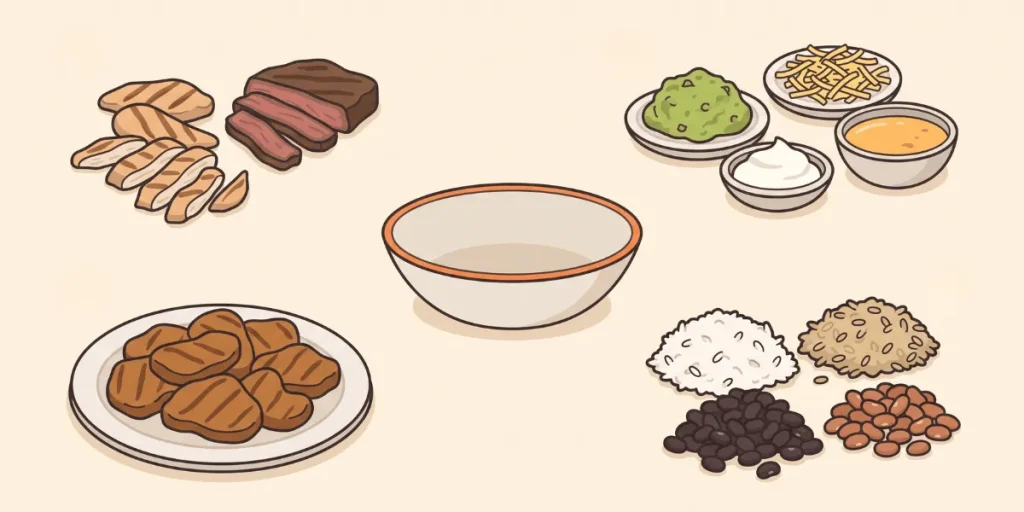
Protein choices can differ substantially even when their listed serving sizes are similar.
Use the live production summary below rather than relying on a static ranking that may become outdated when a protein option changes.
Protein nutrition summary
Compare standard serving values for this ingredient group.
| Ingredient | Serving | Calories | Protein | Carbs | Total Fat | Sodium |
|---|---|---|---|---|---|---|
| 🥩 Barbacoa | 4 oz | 170 | 24g | 2g | 7g | 530mg |
| 🍗 Chicken | 4 oz | 180 | 32g | 0g | 7g | 310mg |
| 🍗 Pollo Asado — Limited time | 4 oz | 180 | 29g | — | — | — |
| 🐷 Carnitas | 4 oz | 210 | 23g | 0g | 12g | 450mg |
| 🥩 Steak | 4 oz | 150 | 21g | 1g | 6g | 330mg |
| 🌱 Sofritas | 4 oz | 150 | 8g | 9g | 10g | 560mg |
| 🍗 Side of Pollo Asado — Limited time | 1 high protein cup | 220 | 37g | — | — | — |
Current limited-time protein: Pollo Asado
Pollo Asado is currently tracked as a limited-time protein. The production dataset lists 180 calories per 4 oz serving. Its 29 g protein figure is a source-derived value from a current first-party published bowl total and verified component values. Nutrient fields that were not established by the reviewed source remain unavailable rather than being inferred.
Chipotle Chicken Macros
The current standard Chicken serving is 4 oz and lists 180 calories, 32 g protein, 0 g carbs, and 7 g fat.
Chicken
Protein · 4 oz
Chipotle Steak Macros
The current standard Steak serving is 4 oz and lists 150 calories, 21 g protein, 1 g carbs, and 6 g fat.
Steak
Protein · 4 oz
Chicken vs Steak for Protein Efficiency
| Per 4 oz serving | Chicken | Steak |
|---|---|---|
| Calories | 180 | 150 |
| Protein | 32 g | 21 g |
| Carbs | 0 g | 1 g |
| Fat | 7 g | 6 g |
| Protein per 100 calories | 17.8 g | 14.0 g |
INTERPRETATION
Chicken currently provides more protein per listed serving and more protein per 100 calories, while Steak has fewer calories per listed serving. That does not make either option universally better; the useful choice depends on the rest of the meal and the macro you are prioritizing.
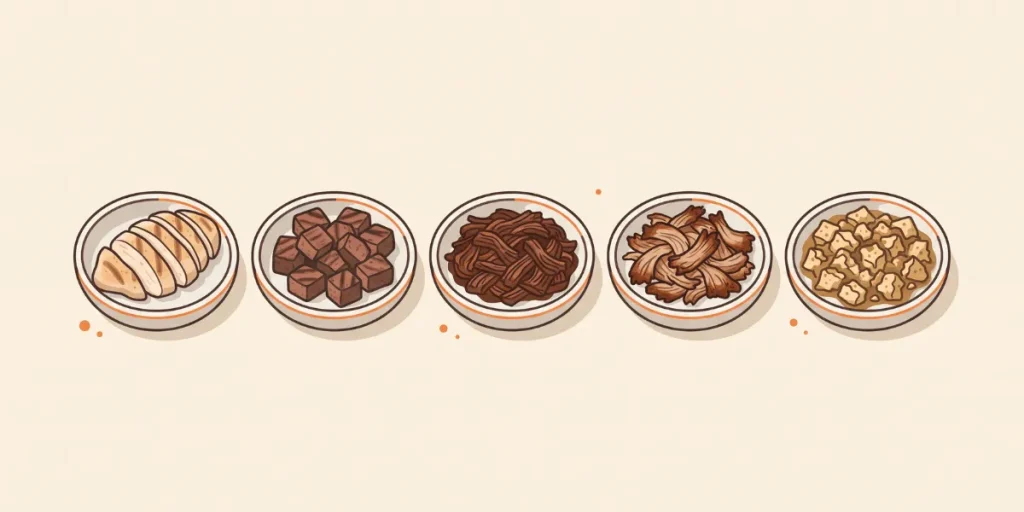
For a deeper order-building approach focused on High Protein Chipotle, use the High-Protein Chipotle guide.
Chipotle Carbs: Rice, Beans, Tortillas and Sides
Carbohydrates can come from several parts of the order at the same time. A tortilla, rice, beans, salsa, chips, sweetened drink, or other carb-containing addition can each contribute to the total.
White Rice vs Brown Rice
The current adult rice entries both list 210 calories and 4 g protein per 4 oz serving, but their carb and fat profiles differ.
| Per 4 oz serving | White Rice | Brown Rice |
|---|---|---|
| Calories | 210 | 210 |
| Protein | 4 g | 4 g |
| Carbs | 40 g | 36 g |
| Fat | 4 g | 6 g |
| Fiber | 1 g | 2 g |
| Sodium | 350 mg | 190 mg |
Ingredient swap
See how one Chipotle ingredient changes the nutrition totals.
| Metric | Current | Swap | Diff |
|---|---|---|---|
| Calories | 210 | 210 | 0 cal |
| Protein | 4g | 4g | 0g |
| Carbs | 40g | 36g | -4g |
| Fat | 4g | 6g | +2g |
| Sodium | 350mg | 190mg | -160mg |
Diff = Swap minus Current. Estimates use listed serving values from Official Chipotle nutrition sources, March 2025 PDF + August 2026 calculator rows + September 2026 current-menu sync.
INTERPRETATION
Equal calories do not mean equal macros. In the current data, Brown Rice has 4 g fewer carbs, 2 g more fat, 1 g more fiber, and 160 mg less sodium than White Rice per listed serving.
Black Beans vs Pinto Beans
The adult bean entries are even closer.
| Per 4 oz serving | Black Beans | Pinto Beans |
|---|---|---|
| Calories | 130 | 130 |
| Protein | 8 g | 8 g |
| Carbs | 22 g | 21 g |
| Fat | 2 g | 2 g |
| Fiber | 7 g | 8 g |
| Sodium | 210 mg | 210 mg |
A one-gram carb difference exists in the current serving data, but it is usually more useful to evaluate the complete meal than to treat that single gram as decisive.
If your broader goal is Low Carb Chipotle, use the Low Carb goal in a meal type where it is currently enabled—such as Burrito Bowl or Salad—to make carb-heavy choices easier to review without changing the underlying nutrition math.
Chipotle Fat: Toppings and Extras Matter Too
Fat does not come only from the main protein. Toppings and extras can materially change a meal’s macro profile even when their serving sizes are smaller than the entrée itself.
| Item | Serving | Calories | Protein | Carbs | Fat |
|---|---|---|---|---|---|
| Cheese | 1 oz | 110 | 6 g | 1 g | 8 g |
| Sour Cream | 2 oz | 110 | 2 g | 2 g | 9 g |
| Queso Blanco | 2 oz | 120 | 5 g | 4 g | 9 g |
| Guacamole | 4 oz | 230 | 2 g | 8 g | 22 g |
GOOD TO KNOW
This table is not a “remove these foods” list. It shows that different extras change protein, carbs, fat, and calories in different proportions. The right choice depends on the rest of the meal and what you are trying to compare.
Bowl Macros vs Burrito Macros
Meal format can change the starting macro profile before the rest of the ingredients are added.
| Starting structure | Burrito Bowl | Burrito |
|---|---|---|
| Locked flour tortilla | No | Yes |
| Baseline calories | 0 | 320 |
| Baseline protein | 0 g | 8 g |
| Baseline carbs | 0 g | 50 g |
| Baseline fat | 0 g | 9 g |
| Baseline sodium | 0 mg | 600 mg |
That tortilla baseline is the main structural difference when comparing Chipotle bowl macros with Chipotle burrito macros using otherwise similar fillings.
MEAL STRUCTURE MATTERS
A bowl is not automatically lower in calories, carbs, or fat than every Burrito. A heavily customized bowl can exceed a simpler Burrito. The table isolates only the starting tortilla difference.
Use the Chipotle Bowl Calorie Calculator for Bowl-specific building, or Chipotle Burrito Nutrition for the tortilla baseline and Burrito-specific structure.
Example Macro Subtotal
A simple three-item Bowl subtotal demonstrates how ingredient macros combine:
- Chicken
- Brown Rice
- Black Beans
| Partial build | Calories | Protein | Carbs | Fat | Fiber |
|---|---|---|---|---|---|
| Chicken + Brown Rice + Black Beans | 520 | 44 g | 58 g | 15 g | 9 g |
DATA NOTE
This is an original subtotal calculated from the current listed servings. It is not an official named menu item, recommendation, or complete Bowl. Toppings, extras, sides, drinks, and supported portion changes would change the final result.
This is where Chipotle macros become more useful than isolated ingredient numbers: each addition changes the complete balance of protein, carbohydrates, fat, calories, and other nutrients.
How to Calculate the Macros in Your Full Meal
Use the homepage when you want a Chipotle macro calculator or Chipotle macro counter for a complete order.
| Step | What to do |
|---|---|
| 1. Choose meal type | Select Burrito, Burrito Bowl, Salad, Tacos, Quesadilla, Kids Meal, or Chips & Sides |
| 2. Choose a goal | Select the planning goal you want the interface to emphasize |
| 3. Choose a starting point | Use Build Your Own or an available suggested starter |
| 4. Customize | Add ingredients and supported portions |
| 5. Watch the core totals | Review calories, protein, carbs and fat as the meal changes |
| 6. Open Meal Review | Inspect Ingredient Breakdown and additional available nutrition fields |
Open the Chipotle Nutrition Calculator →
Macro Goals: Protein and Carbohydrates
Nutrition goals can change which suggestions are emphasized without changing the ingredient values. Goal availability is meal-dependent, so a goal can be supported by the calculator overall while being unavailable for a particular meal structure.
High Protein
Makes protein-focused starter ideas and suggestions more visible. Evaluate protein alongside calories, carbs, fat, sodium, and the rest of the build.
Low Carb
Makes carb-heavy choices easier to review. Tortillas, rice, beans, chips, sweetened drinks, and other carb-containing items can all affect the total.
A goal is guidance, not a separate calculation system. If a goal is marked unavailable after you choose a meal type, select a compatible goal or switch to a meal structure that supports the goal you want to use.
What About High Protein Cups?
The current production data includes a Side of Pollo Asado High Protein Cup at 220 calories and 37 g protein. Other nutrient fields are shown as unavailable where the current first-party row does not expose them. The former Honey Chicken cup is retained only as a historical provenance record and is not a current selectable item. Use Chipotle Nutrition Facts or the live calculator for current values.
Data Sources and Macro Accuracy
DATA SOURCE
Foundation: March 2025 U.S. Nutrition Facts publication
Menu review: August 2026 nutrition review + September 2026 current-menu sync
Dataset: Independent and locally maintained
Calculation: Serving-specific ingredient data + applicable meal and portion rules
Important: This is not a live restaurant data feed.
The Chipotle macros on this page are based on the site’s bundled production data, which uses official Chipotle nutrition sources including the March 2025 U.S. Nutrition Facts PDF, an August 2026 U.S. menu nutrition review, and a September 2026 current-menu synchronization.
Primary source links: Chipotle U.S. Nutrition Calculator · March 2025 U.S. Nutrition Facts PDF · Chipotle Allergens & Special Diet
The local dataset is maintained independently rather than live-synced with the restaurant.
For the site’s sourcing and calculation process, see Methodology & Data Sources.
Why Actual Macros Can Differ
Restaurant nutrition values are reference serving values. A real meal can differ because of:
- serving-size variation;
- preparation;
- ingredient availability;
- limited-time menu changes;
- Light, Extra, or Double portions;
- future recipe updates.
IMPORTANT DATA NOTE
If a nutrient was unavailable in the reviewed source, it must be treated as unavailable rather than assumed to be a confirmed zero. Unknown values should not be used to support rankings that require complete nutrient data.
For strict dietary needs, allergies, medical conditions, or final nutrition decisions, check current official restaurant nutrition and allergen information directly.
Found a possible discrepancy? Report a nutrition-data issue or email contact@chipnutcalculator.com.
Frequently Asked Questions
Are these macro estimates official?
No. This is an independent U.S.-focused nutrition resource. It uses bundled data based on official nutrition sources, but the website itself is not operated by, sponsored by, endorsed by, or affiliated with Chipotle Mexican Grill, Inc.
What are the macros for Chicken?
The current 4 oz Chicken serving lists 180 calories, 32 g protein, 0 g carbs, and 7 g fat.
What are the macros for Steak?
The current 4 oz Steak serving lists 150 calories, 21 g protein, 1 g carbs, and 6 g fat.
How much protein is in a complete meal?
There is no universal total. Protein depends on the main protein choice, beans, portions, toppings, extras, sides, and other selected ingredients.
Can I calculate Bowl and Burrito macros?
Yes. Use the dedicated Bowl page or Burrito page for meal-specific structure, or use the homepage calculator for any supported meal type.
Can I track carbs?
Yes. The live calculator tracks carbohydrates alongside calories, protein and fat, with additional fields available in Meal Review where source data exists.
Do nutrition goals change the macro values?
No. When a goal is available for the selected meal type, it changes guidance, starter suggestions, and review messages. It does not alter the underlying ingredient nutrition values.
Compare Ingredients, Then Calculate the Complete Meal
Use the tables and live widgets on this page to understand individual ingredients and format differences. Then use the main calculator when you want Chipotle macros for the exact meal and portions you are planning to order.